
Reading List 2025
& an exploration of how to categorise books geographically
I had been in a reading slump for the most part of 2024. My determined attempts to try and get back into the habit merely fizzled into half-hearted efforts, a bookmark left stuck between the pages I had long abandoned. So it was with much delight, that at the tail end of 2024, I picked up C.S Lewis’s Till We Have Faces, a book I had bought during a Christmas sale years prior but had left perched on the bookshelf. It was an absorbing book, and I relished my newfound routine of devouring a couple pages each night before bed. Shortly after, I decided to embark on Ken Liu’s dynastic epic, beginning with The Grace of Kings. Again, I found myself eager to hop into bed at nightfall, book in hand.
That sparked my foray back into the wonderful world of literature, and I am happy to say that I finished a grand total of 56 books (as of 16 Dec) this year! Of course, it is not the number in itself that is important, but the sufficient volume means that I have had the pleasure of being acquainted with a great many kinds of books, short and long, tickling or heartbreaking, ones with pictures and ones without.
One of my resolutions this year
was to read more Southeast Asian stories. In school, we studied Shakespeare and Arthur Miller (The Crucible, anyone?). I never really had a chance to become acquainted with Southeast Asian stories except at the bookstore pop-ups that came once or twice a year with their foldable tables crammed with tasteful offerings. I’d dip into my savings and over canteen tables or underneath our class desks, we would produce our prized purchases and compare them. It was how I first read the translated works of Yeng Pway Ngon or encountered pieces by local poets.
Increasingly in my adult life, I’ve become more aware of how my knowledge antennae has been oriented towards the West. Trained, in fact, to first pick up material from that part of the world and then to understand subsequent pieces of information in relation to that source. There was a growing desire in me to understand the land that I live on and am surrounded by. What kinds of stories were people writing about it? What experiences would feel familiar or foreign? What realities have I not been exposed to? So I resolved that in 2025, I would find more works by Southeast Asian authors.
Executing that resolution, though, proved to be a tricky challenge. Firstly, in multilingual Southeast Asia, it was not particularly feasible (yet) for me to read literature in its original language, which meant relying on translations - a difficult prospect given the relatively nascent state of the translation industry in the region (a whole other topic for another time).
Secondly, English-language works by Southeast Asian authors were largely coming from the diaspora, which presented another interesting challenge - what is considered Southeast Asian? If a Malaysian author is writing about anti-immigrant sentiments in the United States, is that Southeast Asian? What about a White author writing about the tropics? These questions are not new, surely, but I became personally confronted with them when attempting to educate myself beyond the Western centric sphere I had been largely encased in.
As I began tabulating my reading list, filling in the country of origin on my Notion table proved somewhat to be a Herculean effort. Geographical origins, I realised, are complex. How do I tag the Asian diaspora, based all over the world, writing about an issue culturally unique to a particular region? What about Nina Mingya Powles, who is of Chinese-Malaysian heritage, was born in Wellington, New Zealand and now lives and works out of the United Kingdom? Or of Jhumpha Lahiri, who is a British-American of Indian heritage, yet is so closely associated with the Italian vernacular and whose work is steeped within that influence? How about artist collective Weaving Realities, whose duo hail from Mexico and China, are based in Amsterdam, but whose books interweaves the indigenous histories of Mexico’s communities with their own? If an author is of a certain heritage yet I find no distinct trace of it in the content of the work, do I still label the origin country first? Or do I slap on a label of where the book was published, oftentimes through a publishing house in America or the United Kingdom?
In the end, I have avoided a didactic take on this labelling, preferring to review it on a book-by-book basis. I took into account the book’s angle and content, the cultural diffusion it revealed, and what I felt was important to foreground. For example, in the case of How to Share an Egg by Bonny Reichert, who was born and raised in Canada, I chose to tag Poland first, as the book recounts her adolescent years as the daughter of a Holocaust survivor and explores how she navigates that identity in relation to the history of that locale. In the case of Our Missing Hearts, I have always associated Celeste Ng as Malaysian, but as the story recounts the violence done to the AAPI community in America, I chose to tag America first.
Breakdown by Geography
In accommodating varied definitions of what counts as Southeast Asian, I was able to read widely and get a sense of both the indigenous and diasporic experience. Here is a breakdown of the countries* that I ended up reading from this year:
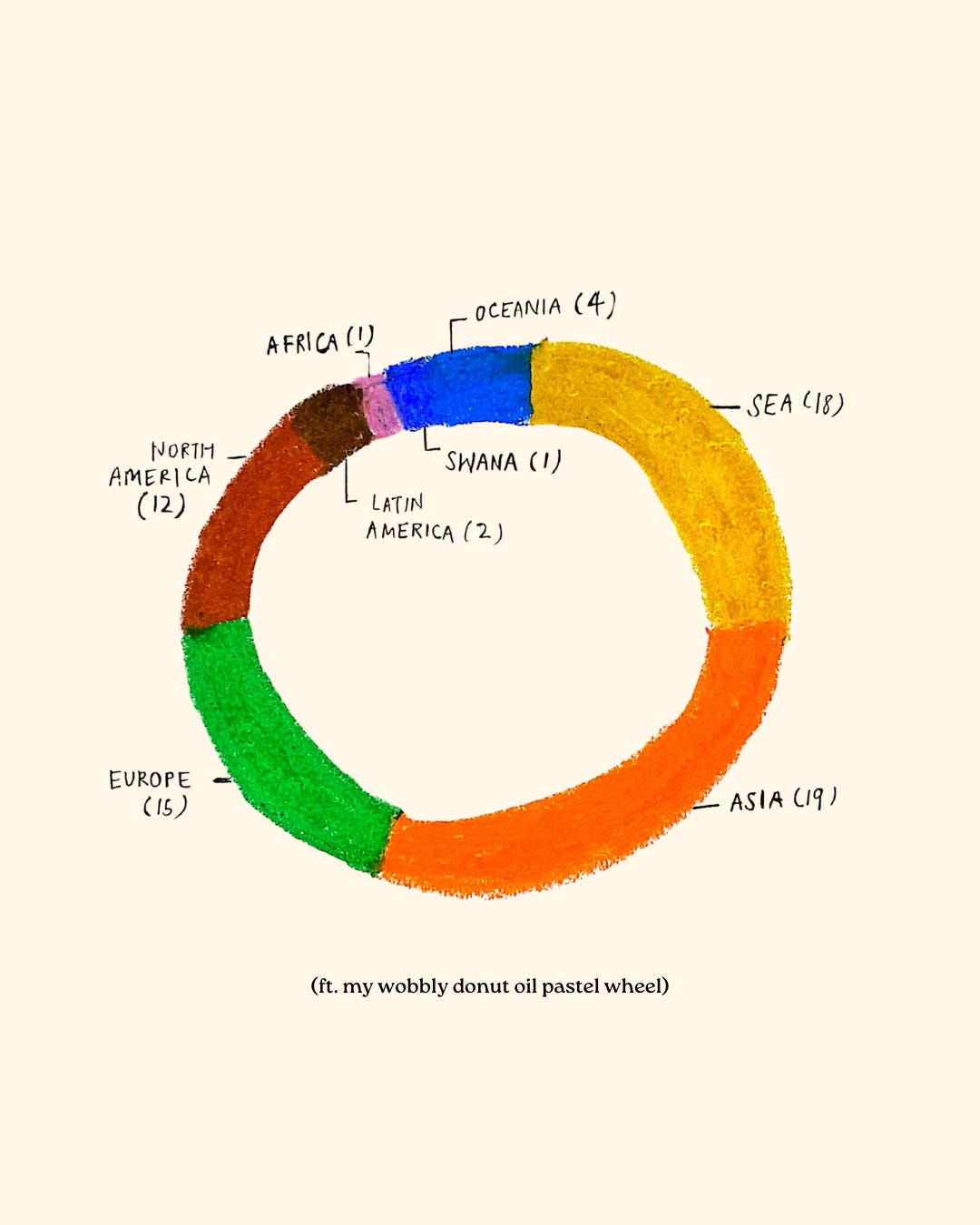
*note that I have double counted books with multiple geographical tags!
Notes on How I Labelled this Reading List
Before I share the complete reading list, here are some notes on the labelling framework:
I chose to emphasise the translators of the works, as I believe that the translation is as crucial as the original act of authorship, influencing the experience of the reader. Translation in itself is an act of creation, and the original manuscript must anticipate a rebirth when passed through the hands of the translator.
I have also broken down the type of book into 7 categories - fiction, non-fiction, creative non-fiction, short stories, zines, cookbooks and graphic novels. There is an 8th category - picture books - but as I read so many picture books this year (courtesy of my work at Gentle Seeds), I have a separate list for it which I shall detail in a different post.
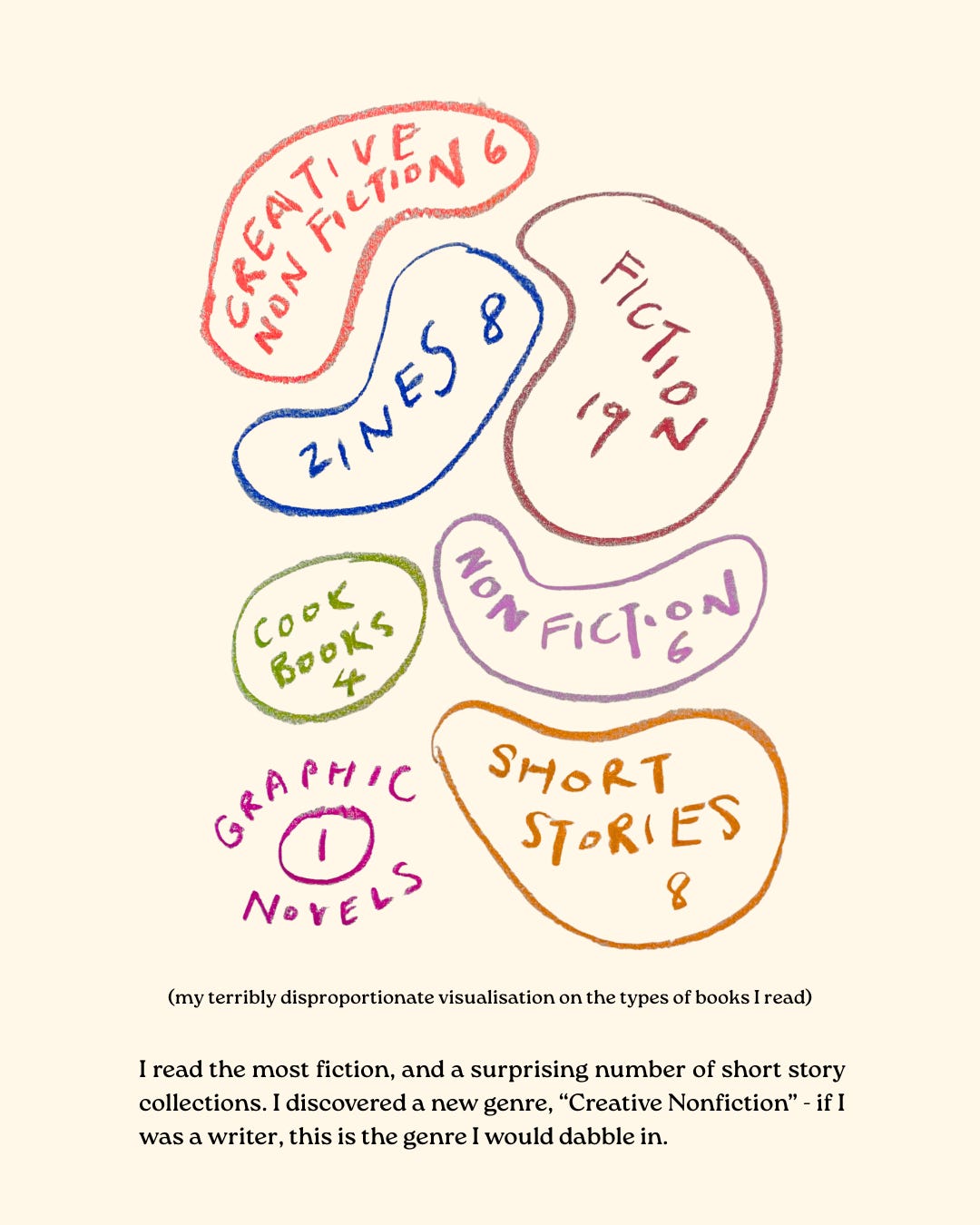
I also tracked which year the book was published to get a sense of how current (or not) I was reading, and it turns out that I’m reading pretty contemporary works (many within the last decade).
Finally, I have also starred my favourites of the year, which are books that delighted and educated me, and that I will have no qualms repeating and recommending to any who might be interested.
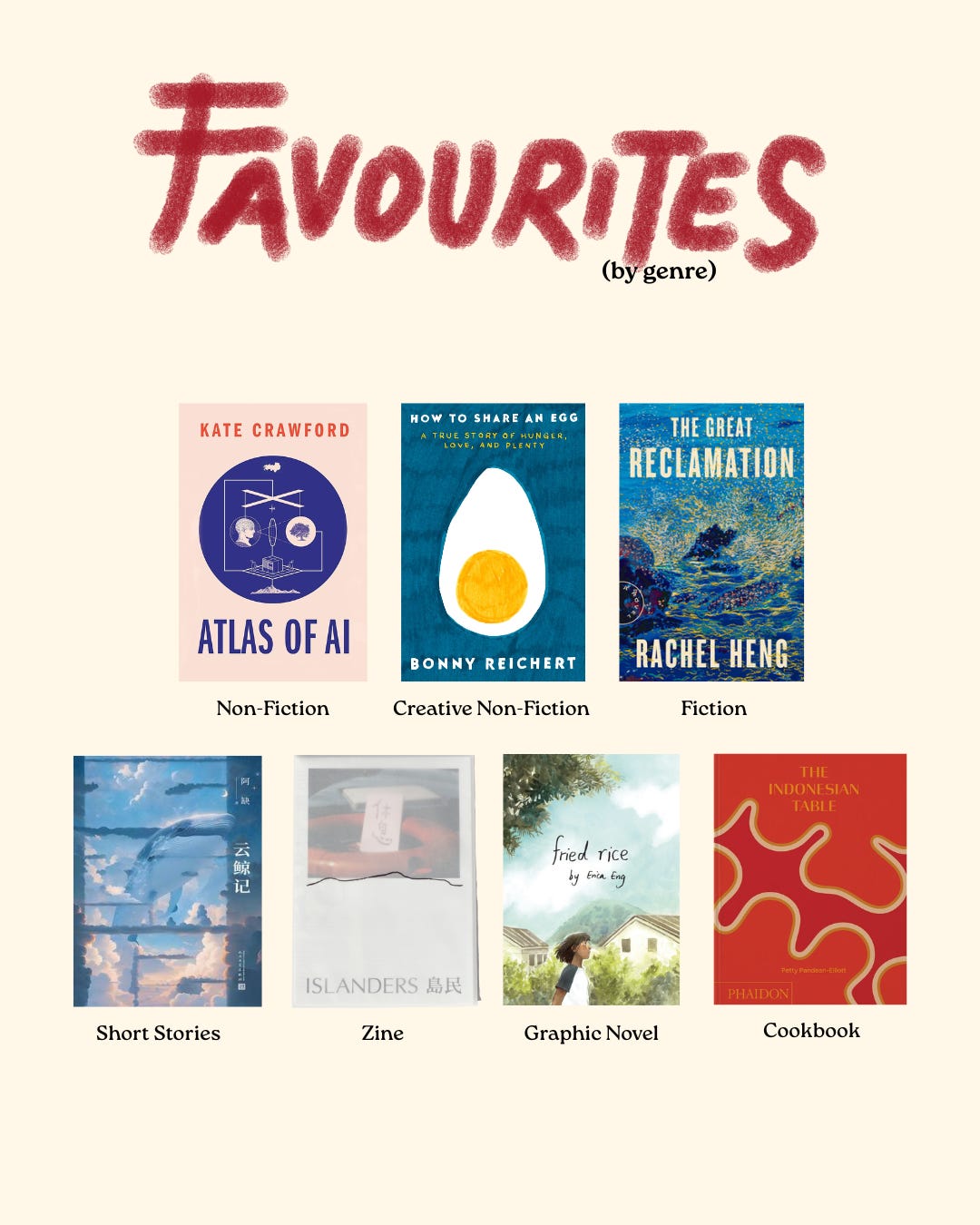
Finally! The Reading List!
And now, without further ado, here is my Reading List for 2025. I’m really happy to share this, and am curious if anyone has read the titles present here. Please share your thoughts with me if you have! I’d also be more than happy to recommend something if you let me know what you might be interested in :) May 2026 be a fruitful reading year for us all!